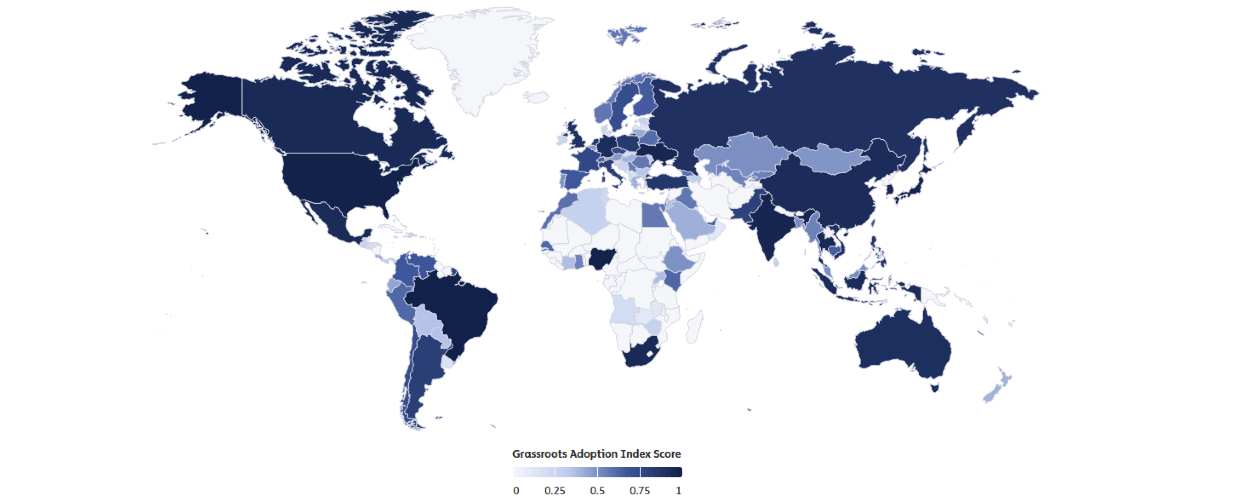


Chainalysis’ 2026 Global Crypto Adoption Index found that cross-border stablecoin transfers rose by 77.5% between June 2025 and June 2026.
According to Chainalysis’ 2026 Global Crypto Adoption Index, cross-border stablecoin transfers saw a boom in usage even as the crypto market went through a severe bear market in the last year.
The latest annual report by the blockchain analytics firm covered the period between 1 July 2025 and 30 June 2026, which saw Bitcoin climbing to its all-time high before seeing its largest-ever dollar-value retreat. While the crypto market’s total capitalisation shrank by roughly US$2.1 trillion, the broader on-chain economy stayed resilient, dipping only by 1.6% from US$9.5 trillion to US$9.4 trillion.
Cross-Border Stablecoin Transfers Surge
Chainalysis reported that cross-border stablecoin transfers rose by 77.5% from US$124.2 billion to US$220.3 billion, while its monthly cross-border stablecoin value estimate more than doubled from US$11 billion in January 2025 to US$24 billion in June 2026.
The growth is mainly attributed to emerging regulatory frameworks, including the GENIUS Act in the US, MiCA in the EU, plus regulatory developments in Japan, Hong Kong, Singapore, and the UK.
The report also points to expansion beyond established payment corridors. Chainalysis tracked 4,708 new corridors that cumulatively moved US$2.64 billion over the stated period.
Stablecoins also proved a stabilising force in on-chain balances with balances holding steady between US$98 billion and US$109 billion throughout the nine-month drawdown, even as non-stablecoin balances fell 55.6%.
All in all, stablecoins’ share of global on-chain balances climbed to 22.5% by June 2026; the rise is mainly attributed to other assets losing value while stablecoin balances held steady throughout.
Brazil Leads the World in Grassroots Adoption
Chainalysis recently adopted a new four-factor methodology to rank crypto grassroots adoption:
- Service inflows: Value received by centralised exchanges, DeFi protocols, and other crypto services
- Within-country P2P: Value moving directly between personal wallets inside the same country
- Cross-border flows: Value that crosses a national border
- Balances: Holdings at a point in time, combining geolocatable personal wallets with the balances held on select services
Taking the geometric mean of these factors, Brazil ranked first in the world for grassroots crypto adoption with a US$252.5 billion crypto economy, despite not coming out top in any of the four factors.
The US ranked second overall, followed by Nigeria, Japan, and South Korea in third, fourth, and fifth place, respectively.
Retail Activity Held Up Despite the Bear Market
Smaller transactions grew fastest of all, with transfers under US$100 rising by 78.4%, while transfers between US$100 and US$1,000 rose 58.6%. Institutional-sized activity stayed resilient, with transfers of US$1 million or more dipping only 7.2% period-over-period.
Peer-to-Peer (P2P) Activity Rallies Globally
P2P activity outperformed other services. Value moving between domestic personal wallets rose 302.9% from US$56.8 billion to US$228.7 billion, with gains recorded in all eight regions that Chainalysis tracks. The report notes that P2P activity is now 96% stablecoin-denominated, a mix it contrasts with service inflows, where non-stablecoin assets still dominate.
Taken together, these trends emphasise that the crypto on-chain economy may be maturing beyond speculative trading and toward habitual, utility-driven use.
Read the report here.
Stay updated on crypto and AI by following our socials.