Chinese-language money laundering networks emerged as significant facilitators of on-chain laundering, processing US$16.1 billion in 2025.
Chinese-language money laundering networks (CMLNs) have become a part of the global illicit crypto economy, accounting for approximately 20% of all known on-chain laundering activity.
According to the Money Laundering chapter of Chainalysis’s Crypto Crime Report, these networks processed an estimated US$16.1 billion in 2025, or roughly US$44 million per day, marking a shift in how illicit cryptocurrency flows are facilitated. The broader illicit on-chain laundering ecosystem has expanded rapidly over the past five years, growing from around US$10 billion in 2020 to more than US$82 billion in 2025.

Within that growth, CMLNs stand out for both their scale and speed. Since 2020, inflows to identified CMLNs have grown 7,325 times faster than illicit inflows to centralised exchanges, outpacing growth across decentralised finance and other intra-illicit on-chain flows. This acceleration reflects the increasing professionalisation of crypto-enabled laundering and the role of specialised service providers.
At the centre of the CMLN ecosystem are guarantee platforms such as Huione and Xinbi, which function as escrow and marketing venues rather than direct operators. These platforms connect vendors and buyers, provide dispute resolution mechanisms, and enable reputation systems similar to those used by legitimate online marketplaces. Enforcement actions against such platforms have proven disruptive, but largely temporary, as vendors quickly migrate to alternative channels without materially altering their operations.
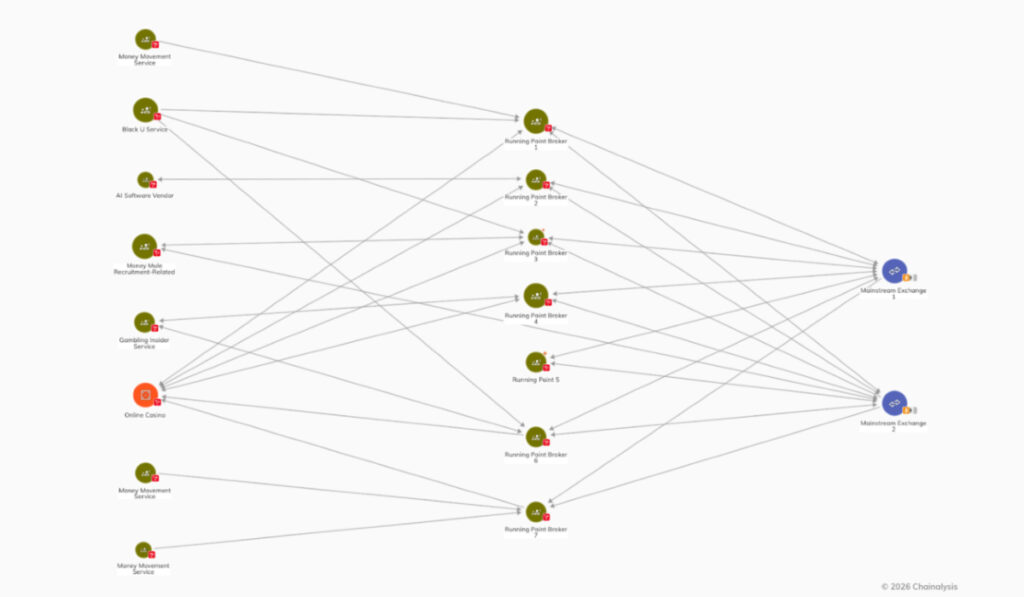
On-chain analysis identifies six distinct service types that together form a comprehensive laundering infrastructure.
- Running point brokers act as initial entry channels by renting financial identities and accounts to receive illicit proceeds
- Money mule networks then facilitate the layering process through complex chains of transactions across bank accounts, wallets, and payment platforms
- Informal over-the-counter and peer-to-peer services circumvent capital controls and regulatory requirements
- Gambling platforms provide integration pathways by blending illicit proceeds with high-volume transactional activity, and money movement services offer mixing and swapping capabilities to obscure fund origins
Transaction data shows that these services replicate traditional money laundering stages on-chain. Black U services exhibit aggressive structuring behaviour, fragmenting large sums into numerous small transfers, while OTC desks and gambling insiders act as aggregators, consolidating funds into wholesale amounts suitable for reintroduction into the financial system. High-value transactions are prioritised across all typologies, with some automated services clearing large transfers within minutes, underscoring the industrial efficiency of these operations.
The rise of CMLNs also highlights broader enforcement challenges. These networks are highly resilient, geographically dispersed, and tightly integrated with off-chain criminal ecosystems. Targeting advertising venues or individual platforms alone has a limited long-term impact. Instead, effective disruption requires identifying and dismantling the underlying operators, supported by coordinated public–private collaboration that combines blockchain analytics, open-source intelligence, and human intelligence.
Overall, the data indicate that CMLNs are no longer a peripheral feature of crypto crime. They represent a durable infrastructure underpinning a substantial share of global illicit cryptocurrency laundering, with implications for financial crime compliance, sanctions enforcement, and international security
Stay updated on crypto and AI by following our socials.