

Flow outlines a Consumer DeFi roadmap built on enshrined protocols, a new credit market, and updated fees.
Flow has unveiled a new strategy focused on “Consumer DeFi” as it moves into the next phase of its development as a consumer-first Layer 1 network. After onboarding more than 15 million users, minting over 200 million digital assets, and partnering with brands such as the NBA, NFL, Disney, and Live Nation, Flow now aims to turn decentralised finance into practical products designed for everyday users, not just crypto-natives.
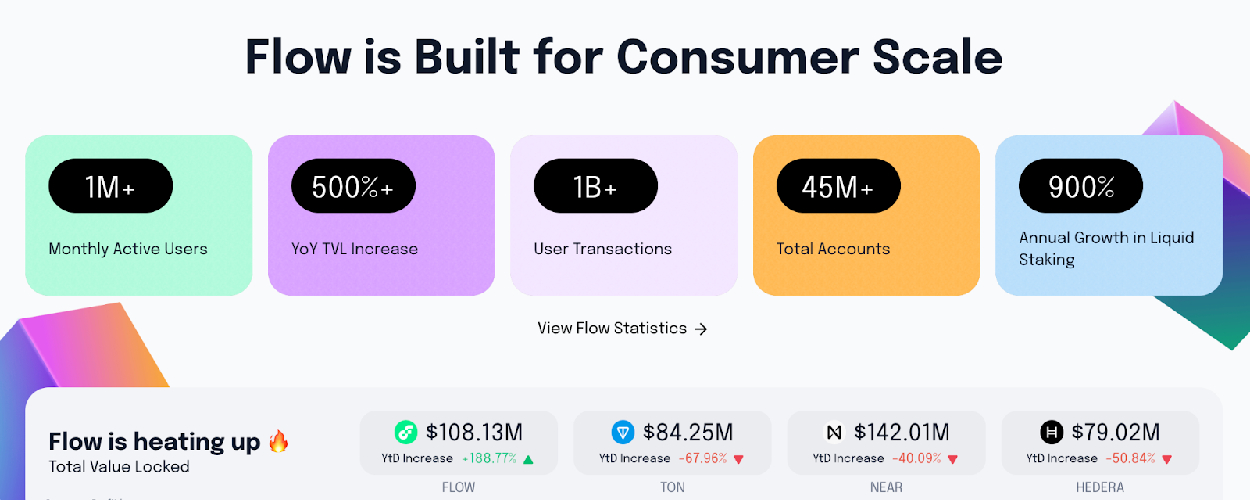
Over the past year, Flow has strengthened its infrastructure with upgrades such as the ‘Forte’ release, which introduced on-chain automation, and has seen total value locked grow by 500% year-on-year to more than US$100 million.
Flow argues that while DeFi infrastructure has matured, user experience remains complex and risky for most consumers. Its Consumer DeFi vision focuses on protocol-level safeguards, sustainable yield, and products that can be safely accessed through simple, mobile-first interfaces.
Enshrined Protocols and Flow Credit Market
A cornerstone of this strategy is the introduction of “enshrined protocols” – DeFi primitives embedded directly into the network and treated as public utilities. These are designed to provide shared liquidity and reduce fragmentation across key verticals.
The first of these is Flow Credit Market (FCM), an automated lending protocol that uses Flow’s native on-chain scheduling to set recurring triggers without external oracles. The design aims to maximise loan-to-value ratios while reducing liquidation risk, supporting more stable, risk-adjusted returns for lenders and borrowers.
To drive adoption, Dapper Labs is launching Peak Money, a consumer finance application built on FCM. Targeted at mainstream users, it aggregates yield opportunities across chains and presents them through a seamless, mobile-first experience. A waitlist is now open at peak.money.
Updated Fees and Deflationary Economics
Flow is also updating its transaction fee model as it transitions from subsidised growth to a more sustainable phase. With automated strategies and on-chain rebalancing expected to increase network activity, the new fee structure links usage more directly to network value.
Under the revised economics, the FLOW token is designed to become net deflationary at a sustained throughput of around 250 transactions per second, a level Flow expects to reach as Consumer DeFi applications scale.
Despite the adjustments, Flow says its fees will remain well below those of many other networks, supported by its underlying architectural efficiency.
Stay updated on the crypto space by following our socials