

Vault Summit’s inaugural Asia edition wrapped up in Singapore with panels on vault risk and tokenised assets.
Vault Summit’s inaugural Asia edition concluded on 9 October 2026 at Andaz Singapore, organised by event agency Party Action People, hosted by Morpho, and co-hosted by DigiFT and S&P Global Ratings.
The summit explored how institutions assess and deploy capital across different vault strategies, and saw speakers from firms including Franklin Templeton, Fidelity Digital Asset Management, and Standard Chartered. Here are some of the key points from the speakers and panels:
Scaling On-Chain Asset Management
Robbie Klages, Co-Founder at The Rollup, moderated a panel on scaling on-chain asset management with Adam Haeems, Head of Asset Management at Tesseract; Jonathan Man, Head of DeFi Strategies at Bitwise Asset Management; and Giselle Lai, Director, Digital Asset Strategist, APAC at Fidelity International.
Asked whether institutions are racing to adopt digital assets, Man pointed to growing interest among established financial institutions in accessing new products, building them, and using the technology for distribution. He said those stuck in the crypto ecosystem may feel bearish, but “when you take a step back, you realise this is only starting to increase and pick up.”
Lai outlined how digital asset strategies typically develop through three stages: holding assets, earning yield, and putting assets to use through new on-chain applications. Man added an optimistic note on the pace of innovation: “This is the age of fast finance for us, where we can create products very quickly and iterate very fast.”
Fireside Chat: The Role of Vaults in On-chain Asset Management
Henry Zhang, Founder and Group CEO at DigiFT, led a fireside chat with Wayne Hsu, Executive Vice President at KGI Financial, on how vaults work in on-chain asset management.
Hsu explained: “The vault is a strategy wrapper with rules built in.” Whereas a traditional mandate lives in legal documents and can only be enforced through after-the-fact monitoring, constraints on leverage, concentration, counterparties, or rebalancing in a vault can be coded and enforced in real time.
Fireside Chat with Insung An
Insung An, CDO at Hanwha Investment & Securities, joined a fireside talk moderated by Shui Shan Shan, Fintech Growth at Morpho, on the firm’s business development and the institutional responsibilities involved in trade execution.
An outlined three safeguards the firm requires before executing trades: rules are checked before the trade, so anything that breaks risk policy is not executed.
A full record is made so the firm can show an auditor or regulator what happened without explaining it from memory, and responsibility for decision-making during emergencies is clearly assigned.
“If a price feed fails or something happens, if you need to ask who holds the key, it’s too late,” An said.
Circle on Enterprise Infrastructure and Tokenised Equities
Matt Enslin, Senior Manager, Arc & Global Ecosystem at Circle, discussed the infrastructure challenges enterprises face when building on-chain products and the potential for tokenised equities to drive the next wave of adoption.
On barriers to enterprise adoption, Enslin identified gas fees as the main historical challenge. He said having to hold volatile crypto assets such as ETH or SOL makes accounting and treasury management for on-chain products nearly impossible.
Looking ahead, Enslin identified tokenised equities as a potential catalyst, drawing a comparison with the growth of stablecoins. He said his belief is that tokenised equities “are going to be the largest demand driver for tokenisation on-chain since the birth of stablecoins late last decade.”
Bringing TradFi Practices to Vaults
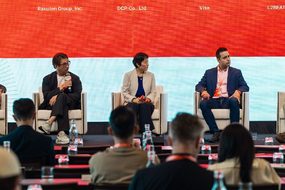
Michael Poluy of Fordefi by Paxos moderated a panel with Nassim Alexandre of RockawayX, Dennis Dinkelmeyer of Midas, and Jon Libby of BNB Chain on how vaults can draw on established TradFi practices while addressing the challenges of scaling on-chain finance.
Dinkelmeyer challenged the stigma around leverage in DeFi, pointing to its established role in traditional markets.
Looking ahead, Dinkelmeyer identified duration as a key factor in expanding vault adoption and competing with traditional fixed-income products such as 10-year US government debt.
Stay updated on crypto and AI by following our socials