

Stablecoin Summit 2026 wrapped up in Singapore with panels on enterprise payments, liquidity, and agentic payments.
Stablecoin Summit 2026 concluded on 8 October with participants from financial services and regulatory sectors discussing the development and use of stablecoins across financial markets.
The summit examined different forms of digital money, including central bank digital currencies (CBDCs) and DeFi-based stablecoins, with discussions spanning payments, settlement, and agentic AI payments. Here are some key points discussed throughout the session:
Non-USD Stablecoins and CBDCs
Qin En Looi, managing partner at Onigiri Capital, led a panel on how the stablecoin ecosystem is evolving through non-USD currencies, CBDCs, and regulatory integration.
Liu Tianwei of StraitsX said the true value of stablecoins lies in payment efficiency and FX finality, and advocated for abstracting the underlying technology. He pointed to small, inbound cross-border purchases as the most sensible starting point from both a risk and pain-point perspective.
Rita Liu of RD Technologies noted that stablecoins and CBDCs each offer unique advantages, and positioned Hong Kong as a key bridge where the two would eventually converge. “Financial services can be changed for the better and money moving can be changed for the better,” said Liu during the panel.
Stablecoins in Enterprise and B2B Payments
Steve Vallas, CEO of Blockchain APAC, joined Coral Taylor, Head of APAC Crypto GTM at Stripe, and Debbie Soon, Head of Marketing at Privy, to discuss how payment and wallet infrastructure is adapting to enterprise and B2B needs.
Taylor pointed out that APAC businesses are using stablecoins to go global, particularly into markets such as the US and LatAm where card authorisation rates are much lower.
Citing Meta’s creator payout system, Taylor said: “Creators in the Philippines and Cambodia don’t want to hold their local currency; they would love to hold USD. So, paying out in stablecoins was cheaper for Meta, and it benefits the creators.”
Vallas closed the panel on an optimistic note, saying that in a year’s time the industry would be focused on active, real-world use cases and established products.
Digital Assets in the Enterprise
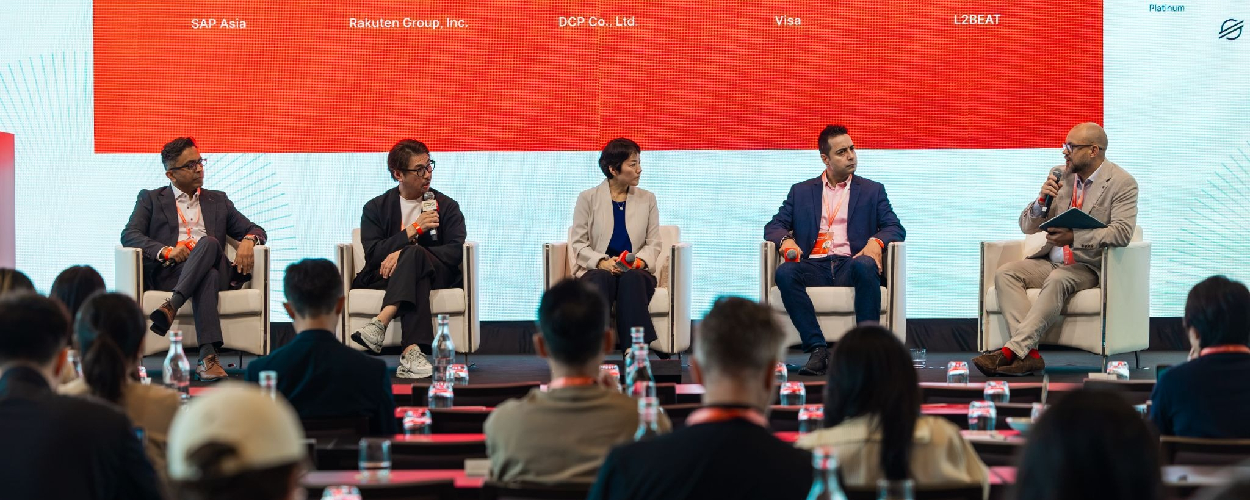
Krzysztof Urbanski, Head of Partnerships at L2BEAT, led a panel on how digital assets are being integrated into today’s business landscape.
Sanchit Mall, Director of Digital Currencies for Asia Pacific at Visa, said that institutions new to the stablecoin ecosystem can plug into its system to mint, burn, send, receive, and hold the asset.
Tushar Gulhane, VP, Treasury and WCM at SAP Asia, said that SAP “is moving very fast into the autonomous enterprise space,” and closed the discussion by saying that companies will be looking at multi-rail orchestration, with programmable money and smart contracts taking centre stage in how they contract and settle.
Stablecoins as Cash Equivalents
Julie Nguyen, Head of People and Talent at Rain, moderated a panel on what needs to be true for stablecoins to be counted and treated as cash equivalents in light of recent regulatory and accounting guidelines.
Michal Selbka of S&P Global Ratings stated that asset quality, covering both credit and market risk, is the key aspect of S&P’s stablecoin stability assessment, with governance and transparency also critical factors.
Will Nuelle of Galaxy Ventures added that checking reserves also means understanding how an entity is legally structured and where stablecoin holders rank against other creditors, a risk he said is under-discussed.
Nguyen concluded that for stablecoins to qualify as cash equivalents, their redemption mechanics, ratings, and reserves must withstand strict scrutiny, and that the tools needed to deliver that transparency are being built.
Fireside Chat with Raja Chakravorti
Viktor Yelizarov, Head of Strategy and Investments at Cointelegraph, spoke with Raja Chakravorti, Chief Business Officer at the Stellar Development Foundation, about stablecoins and their applications in the real economy.
Chakravorti pointed out during the discussion that the architecture for stablecoins was already built within Stellar, and that what changed was the environment outside it. He noted that banks are not inspired by new technology but by “whether it gets past the risk committees before going through the compliance committee.”
On Asia’s potential for global leadership in stablecoin adoption, Chakravorti pointed to forward-thinking regulators such as MAS in Singapore and said Hong Kong has a lot of drive to make it happen.
Fireside Chat with Sam MacPherson
Petr Hluze, founding partner of Nammu Capital, spoke with Sam MacPherson, CEO and co-founder of Spark, about liquidity as the battleground for stablecoins.
Asked why liquidity remains the holy grail even as launching a stablecoin has become easier, MacPherson said reaching institutional scale requires a large balance sheet behind it.
“Having a global market where everybody can get access to liquidity in a permissionless way is a huge unlock. It defragments the global markets in general,” MacPherson added.
Fireside Chat with Michael Egorov
When asked about his inspiration for the Curve DeFi platform, Curve founder Michael Egorov recalled that his work on NuCypher, where tokens meant to be staked could be wrapped, led him to anticipate that people would want to move in and out while staked. This prompted the AMM algorithm behind a new type of exchange for swapping stablecoins.
Asked whether institutions should be brought on-chain, Egorov pushed back on top-down adoption, noting that institutions already have deep liquidity for big swaps through interbank rates. “We need to go bottom-up rather than top-down,” he said, adding that institutional on-chain adoption should happen organically, even if it takes time.
Agentic Payments and the Road to Adoption
Francesco Andreoli, Director of Developer Relations at MetaMask, moderated the final panel of the day on agentic payments.
On institutional versus retail adoption, Hassan Ahmed, Singapore Country Director at Coinbase, said: “We haven’t truly seen autonomous agents yet which have intent and have full authorisation.”
He added that governance, operational, and financial risk matters need to be resolved before enterprises of that scale are ready to take the next step.
Vincent Chok, CEO and Founder of First Digital, emphasised that without proper guardrails and user training, retail adoption carries high risk. “This is why regulators exist; it’s to protect the retail consumer,” said Chok, adding that getting to massive adoption is really about education.
Stay updated on crypto and AI by following our socials