

Sumsub’s latest Identity Fraud Report shows deepfakes, AI fraud agents, and synthetic data now define the region’s risk landscape.
Sumsub released its fifth annual Identity Fraud Report 2025–2026, revealing a dramatic acceleration in fraud sophistication across the Asia-Pacific, even as overall fraud volumes stabilise. The study identifies a “Sophistication Shift” driven by AI, professionalised fraud-as-a-service tools, and increasingly organised criminal ecosystems.
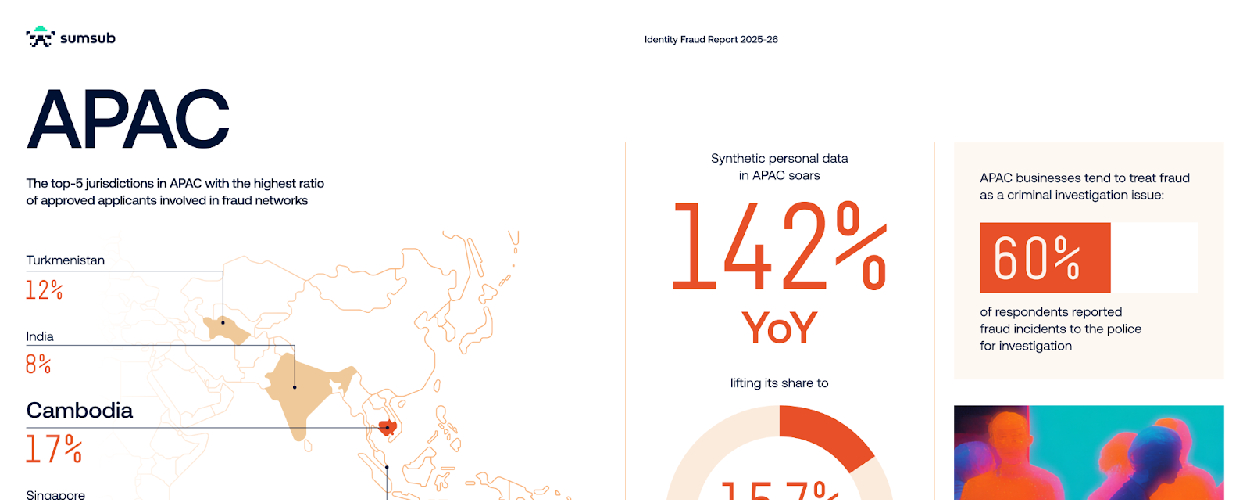
Synthetic personal data fraud grew by 142% year on year in APAC, now accounting for 15.7% of all attacks and emerging as the region’s third-largest fraud category. These attacks combine fabricated identity data with high-quality synthetic profiles designed to evade verification systems, marking a shift from low-effort scams to industrialised digital deception.
Penny Chai, Vice President, APAC at Sumsub, said: “The fraud landscape in APAC has changed faster in the past twelve months than in the previous five years combined. While fraud has declined in mature markets, deepfakes and synthetic identities are rising faster than anywhere else in the world.”
Escalation in Deepfakes and Targeted Identity Attacks
The report highlights explosive deepfake growth across several markets: Maldives (2100%), Malaysia (408%), and Mongolia (200%). Singapore recorded a 12% fall in overall fraud but saw deepfake incidents jump 158% year on year, driven predominantly by impersonation scams and fraudulent e-wallet registrations.
Cambodia reported the highest ratio of approved applicants involved in fraud networks at 17%, followed by Turkmenistan (12%) and Australia (10%). Across APAC, 69% of businesses and 53% of end users reported falling victim to fraud in 2025, with respondents increasingly viewing fraud prevention as a shared responsibility between companies and regulators.
Enforcement Strengthens, But Fragmentation Remains
According to Sumsub’s Fraud Exposure Survey, 60% of APAC companies now report fraud incidents to the authorities, which is more than double that of Europe. Tougher enforcement has exposed the scale of organised networks.
Yet the region remains highly fragmented. Markets like Malaysia and Pakistan are seeing rapid increases in fraud alongside rising digital adoption, while economies such as Indonesia and the Philippines face persistent deepfake-driven threats. Mature markets such as Singapore, Hong Kong, and Australia show progress in lowering fraud volumes, but attackers are rapidly upgrading their methods.
The Rise of AI Fraud Agents and Telemetry Attacks
As verification systems become more robust, fraudsters are shifting to invisible attack vectors. Telemetry tampering, which is the manipulation of SDKs, APIs, and device signals, surged across industries in 2025, enabling fraudsters to mimic legitimate user behaviour.
AI fraud agents also emerged as a new threat class: autonomous systems capable of generating fake documents, producing deepfake videos, and navigating verification flows end to end. These agents can orchestrate entire attack chains at high speed, adapting to defences in real time.
Securing APAC’s Digital Future
As the region’s digital economy accelerates, the report concludes that static verification is no longer sufficient. Organisations must adopt dynamic, multi-layer systems that analyse behavioural patterns, device telemetry, and contextual signals continuously throughout the customer lifecycle.
APAC’s rapid digital expansion has made it both a target and a testing ground for sophisticated fraud. As attackers evolve, the region’s institutions must shift towards real-time, adaptive trust frameworks to safeguard the next phase of digital growth.
Read the full report here.
Stay updated on the crypto space by following our socials