


Chainalysis finds that Singapore and Australia’s institutional activity surged, with Singapore’s institutional activity climbing 94%.
According to Chainalysis’ latest Geography of Crypto report on Central & Southeast Asia and Oceania (CSAO), Singapore’s crypto activity is up 55.4% year-over-year, making it the region’s largest measured economy at US$284 billion.
The growth came despite a 6.8% dip in the region’s crypto economy, but the report also highlighted an uptick in use cases, with most markets in the region growing in at least one area of crypto activity.
The Region’s Largest Crypto Economies
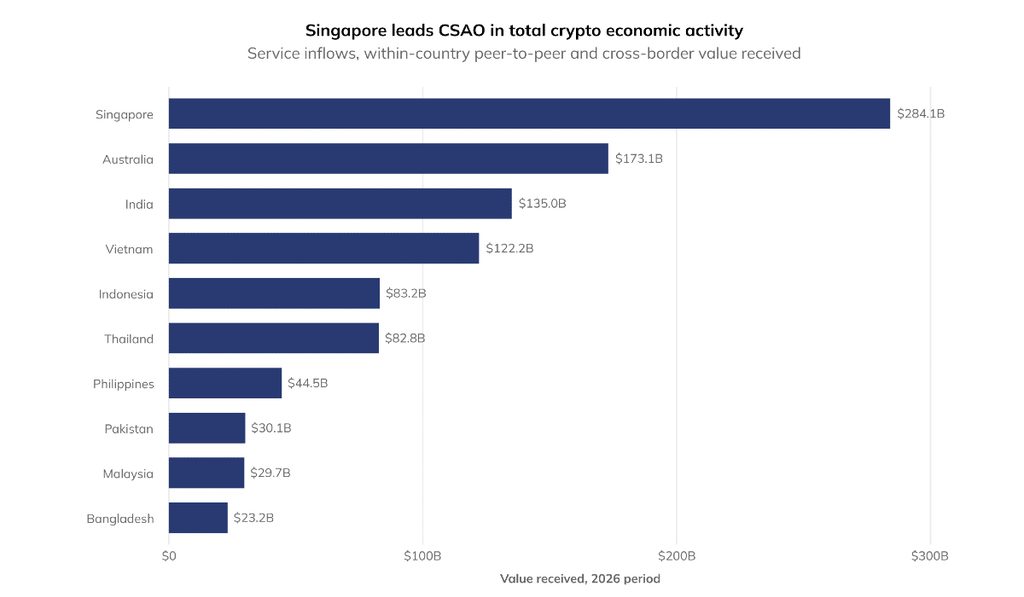
Much of Singapore’s growth came from institutional-platform activity, which rose 94% to US$60 billion. The overall growth in the country was broad-based, with a 30% increase in flows into centralised exchanges (CEX) and a 69% increase in flows into decentralised exchanges (DEX).
Australia was the region’s second-largest digital assets economy at US$173.1 billion. Overall activity fell by 5.6% due to a decline in DEX value flows, though both CEX and institutional-platform activity grew.
Singapore Strengthens Its Position as Regional Crypto-Finance Hub
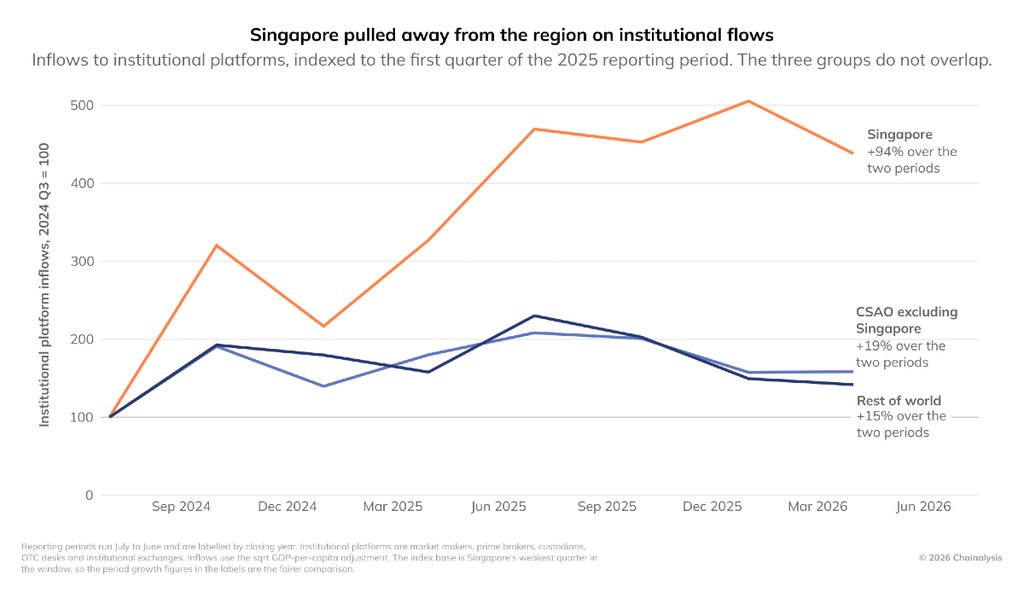
That institutional surge came alongside growth across every major measure except self-custody balances, reflecting the steady development of the regulatory and market infrastructure supporting digital assets.
This includes Singapore’s Digital Payment Token licensing and stablecoin regulatory framework, which provides a relatively clear basis for regulated firms and institutional participants. The island consistently received more cross-border crypto value than it sent, making it a sustained net recipient of these flows. Its cumulative net inflow rose to about US$5 billion by mid-2026.
Additionally, Chainalysis tracks crypto adoption across a financial index that measures trading, staking, and lending activity, and a utility index that measures day-to-day uses like peer-to-peer payments and cross-border remittances. Singapore grew across both indexes with a +47% in utility and a +57% in financial, thanks to its strong overall crypto economy growth and strong institutional adoption.
Stablecoins Become a Key Cross-Border Tool
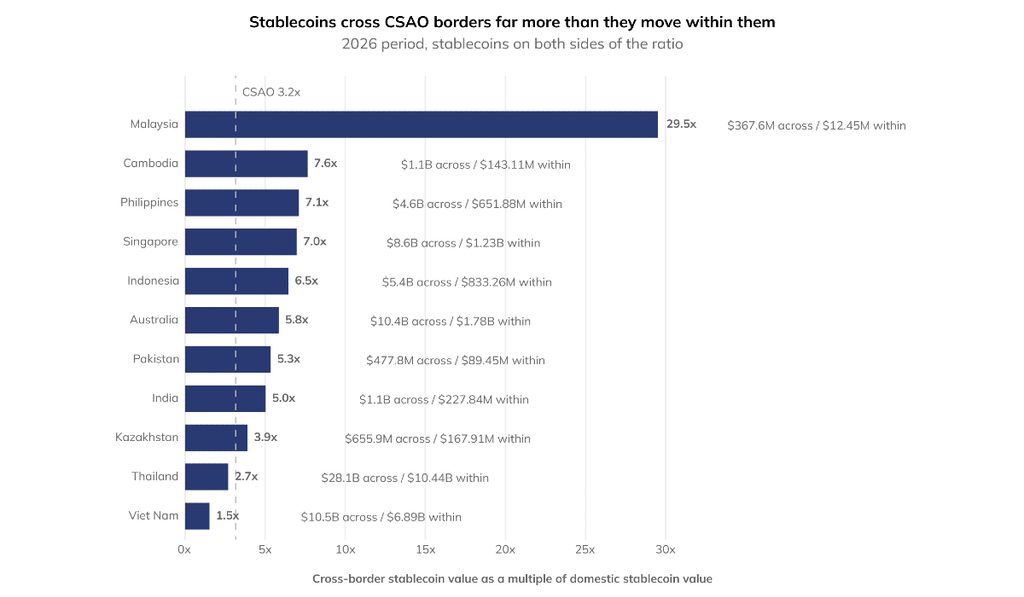
Chainalysis found that cross-border stablecoin activity exceeded domestic stablecoin activity across all countries in the report.
Malaysia showed the widest gap, with cross-border activity 29.5 times larger than domestic activity, against a regional average ratio of 3.2 times. Remittances are also a major driver of this trend in the Philippines, with a huge diaspora population sending funds home.
The Philippines, Thailand, and Vietnam Beat Global P2P Growth
Together, the Philippines, Thailand, and Vietnam recorded 5.4 million small-value peer-to-peer transfers (under US$10,000) during the 2026 period, representing 14.4% of the global total despite these countries occupying only 2.5% of the world’s crypto economy.
Institutional Activity Gains Ground, Opening New Use Cases
Institutional platforms across CSAO processed US$152.3 billion during the reporting period, up 40% year-over-year, with their share of all regional activity rising to 18.9% by the end of Q2 2026. Singapore and Australia lead this institutional conversation regionally, according to Chainalysis.
“The narrative has broadened beyond trading returns to include payments, treasury management, and market infrastructure,” said Daniel Yang, head of compliance at Singapore-based QCP Group.
Other countries like Malaysia, Thailand, and Indonesia are also seeing this shift in institutional mindset locally.
Australia’s Crypto Market Is Broadening
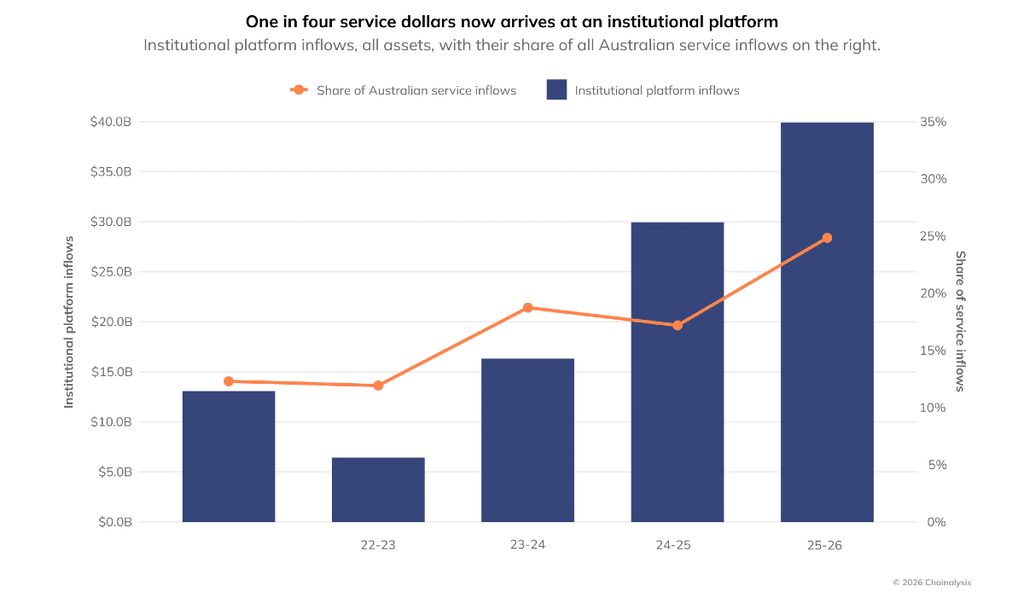
Australia’s institutional platforms received US$40 billion in inflows during the 2026 period, accounting for 24.8% of all Australian service inflows. Market makers accounted for 35% of these institutional inflows, prime brokers and OTC desks another 19%, and custody and collateral providers 26%.
Tokenisation is also gaining attention within the country, with Project Acacia, a joint initiative of the Reserve Bank of Australia (RBA) and Digital Finance Cooperative Research Centre, exploring how digital money and tokenised assets can be used across wholesale financial market use cases.
Amy-Rose Goodey, CEO of the Digital Economy Council of Australia, points out that new regulatory measures have helped increase confidence among institutional actors.
Additionally, Australia saw strong cross-border activity with stablecoin transfers rising from 100,000 in 2021–22 to about 2 million in 2025–26.
India’s CEX Activity Remains Strong
India received US$88.4 billion in CEX inflows between July 2025 and June 2026, which places it ahead of Singapore (US$82.3 billion), Australia (US$79.3 billion), and Vietnam (US$69.8 billion).
While India’s CEX inflows have been volatile quarter to quarter, Chainalysis’ relative-growth index shows they’ve broadly tracked the rest of CSAO over the full period.
Read the report here.
Stay updated on crypto and AI by following our socials.