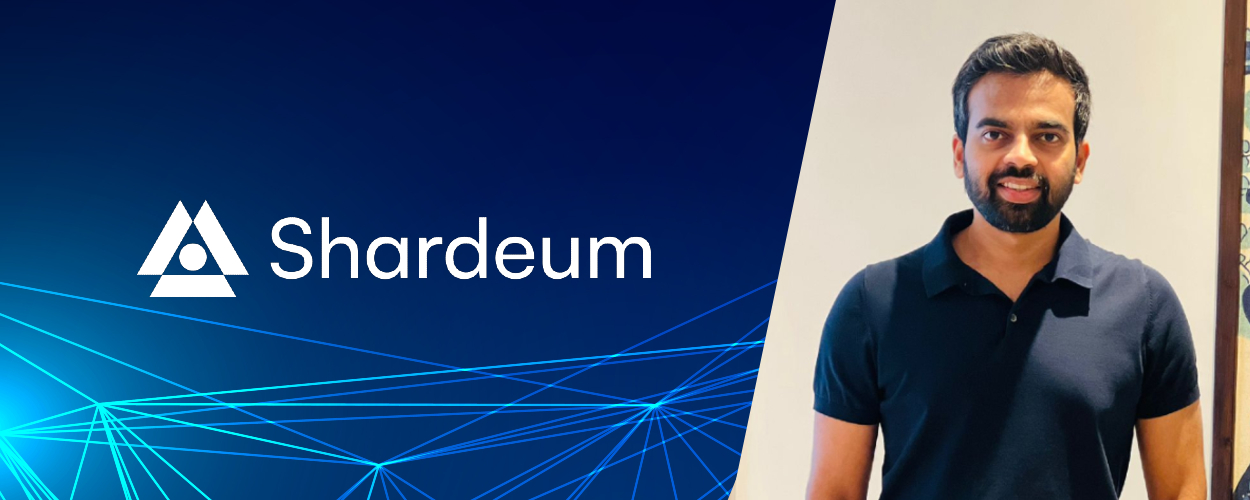


Nischal Shetty, co-founder of Shardeum and CEO of WazirX, explores how India can make the transition onto the blockchain by the next decade.
When India launched Aadhaar and UPI, it wasn’t just digitising paperwork or speeding up payments. It was making a bold bet: that shared digital rails, built once and opened to everyone, could fundamentally reshape the economy. That bet paid off.
UPI now processes more than 18 billion transactions every month and accounts for nearly half of the world’s real-time digital payments. Countries across Africa and Asia are trying to replicate what India built in under a decade. The India Stack proved something powerful: that public digital infrastructure, when designed well, doesn’t just improve services, it creates entirely new economic possibilities. But the world isn’t standing still.
While we celebrate what UPI achieved for payments and Aadhaar achieved for identity, a new infrastructure layer is taking shape globally, one built on programmable, verifiable, on-chain systems. This shift is often misunderstood as crypto speculation. In reality, it’s about how ownership, assets, and value move in a digital-first world.
Tokenised real-world assets crossed $21 billion in on-chain value in 2025, up from just $85 million five years ago. Global institutions like BlackRock and JPMorgan have launched tokenised financial products. Nasdaq has filed to enable trading of blockchain-based securities.
At the policy level, frameworks like the OECD’s Crypto-Asset Reporting Framework are being adopted, while regions such as Singapore, Dubai, and the EU are positioning themselves as regulated hubs for this new economy. The plumbing of global finance is being rebuilt, and the blueprints are being drawn right now. What many people miss is that India isn’t starting from scratch.
India already has real, working on-chain systems. The National Blockchain Framework has verified over 34 crore documents on-chain, including land records, academic certificates, and driving licences. Karnataka’s Aushada platform tracks pharmaceutical supply chains on a distributed ledger. IFSCA has released a consultation paper on tokenisation of real-world assets.
MeitY’s blockchain strategy aims to build “Made in India” blockchain infrastructure ready for global use by 2027. These are not pilots gathering dust; they are live systems. The foundation exists. What’s missing is the leap from digitising records to enabling programmable ownership.
The India Stack solved two critical problems: how people prove who they are, and how they move money. The next layer must solve how people own, verify, and exchange value digitally. Imagine a farmer’s land title represented as a verifiable on-chain asset that can be used as collateral for a microloan without weeks of paperwork or multiple intermediaries.
Imagine a retail investor in a Tier-3 city owning a fractional share of commercial real estate in a metro city. Imagine cross-border trade between an Indian exporter and an African buyer settling in minutes instead of days. None of this is theoretical. The technology already works. What’s missing is infrastructure-level commitment. Talent is not the problem.
India added 4.7 million developers on GitHub last year, and Indian builders now make up nearly 12% of the global Web3 community. More than 1,200 Web3 startups are active in the country today. The builders are already here. What they lack isn’t ambition, it’s institutional support. They need sandbox environments, clear interoperability standards, and a legal framework that treats blockchain as infrastructure, not just as a financial risk.
For India to fully step into this next phase, three things need to happen. First, blockchain infrastructure must be treated as a public good, just as UPI was. Early efforts like Vishvasya and NBFLite are important, but they need real institutional backing.
Second, the regulatory conversation must expand beyond trading and taxation to include tokenisation, decentralised identity, and smart-contract enforceability. And third, India must actively help shape global standards rather than adapting to rules written elsewhere.
Digital India showed what happens when a country of 1.4 billion commits to shared infrastructure. The next decade asks the same question at a deeper layer, not how people pay, but how they own. India already has the foundation, the builders, and the governance ambition. What it needs now is the conviction to treat the on-chain layer with the same urgency it once gave UPI. That window will not stay open forever.
Nischal Shetty is the co-founder of Shardeum and CEO of WazirX, India’s largest crypto exchange by volume. He is a well-known entrepreneur with over a decade of experience building and scaling global products out of India. A software engineer by education, he has also founded Crowdfire, a social media management product with over 20 million users in the past.
Stay updated on crypto and AI by following our socials